Why the right question matters more than a script
Your engineer just told you they’re “fine.” You know they’re not. What you ask next either opens the conversation or ends it right there, and that’s the real reason canned question lists so often fail: they give you words to say, not judgment about which situation you’re actually in.
The questions below aren’t a script to run through in order. They’re organised by situation — a new hire’s first weeks, a stalled career conversation, a report who’s gone quiet, a rough sprint. Pick the ones that fit the moment you’re in, drop the rest, and let silence do some of the work a good question can’t.
Questions to open a 1:1 and set the tone
The first two minutes of a 1:1 decide whether the next twenty-eight are a status update or a real conversation. Open with “what did you work on this week” and you’ll get exactly that — information that’s already sitting in the ticket tracker. Open with something only a conversation can surface instead.
- What’s on your mind that isn’t on the agenda?
- What’s the most interesting problem you’re working on right now?
- Is there anything I should know before we get into the rest of this?
- What would make this a genuinely useful thirty minutes for you?
- What’s been energising you lately, and what’s been draining you?
- Anything from last time that’s still unresolved for you?
Questions for a new hire’s first few 1:1s
New reports are evaluating you as much as you’re evaluating them. The first few 1:1s set the norm for how honest they’ll be with you for the next two years, so ask questions that reward candour early, while the stakes still feel low.
One engineering manager I know asks every new hire the same question in week one: “What’s confusing you right now that you’re embarrassed to ask about in the team channel?” It surfaces exactly the onboarding gaps that a public channel never will.
- What’s confusing you right now that you haven’t asked about publicly?
- What did the interview process lead you to expect that turned out to be different?
- Who have you talked to so far, and who do you still need an introduction to?
- What’s slowing you down that has nothing to do with the code?
- What would “a great first ninety days” look like from where you’re sitting?
- What do you need from me that you haven’t gotten yet?
Questions for career growth and development conversations
Career conversations stall when they only happen once a year, during a review cycle when the answer is already tied to a rating. Ask about growth in ordinary 1:1s, months before any calibration meeting, so the conversation is about the person and not the paperwork.
Vague goals produce vague progress. “Become more strategic” isn’t something either of you can check on in a month. “Own the technical proposal for the next migration” is.
- What’s a skill you want to be known for in two years that you’re not known for today?
- What kind of work makes you lose track of time, and how do we get you more of it?
- Looking at the last promotion in this track, what’s the gap between that bar and where you are now?
- What would you want to be doing that you’re currently not getting the chance to do?
- Whose path here do you admire, and what about it interests you?
- What’s one project in the next quarter that would stretch you in the right direction?
- Is there a skill you’re avoiding because you’re not good at it yet?
- What does “no longer needing me for this” look like for your current responsibilities?
Questions to ask when something feels off
You notice it before you can name it: shorter answers, a camera that stays off, a status that says “heads down” more than usual. Naming the specific pattern you observed, without diagnosing it for them, almost always works better than talking around it.
Rather than guessing at burnout or disengagement, describe the concrete thing you saw and ask what it means: “You’ve turned down the last three pairing sessions — is that intentional, or has something changed?” gets further than “are you okay?”
- I’ve noticed [specific, observable change] over the last few weeks — what’s going on?
- Is this a busy patch, or has something changed longer-term?
- Is this about the work, the team, or something outside work?
- What would need to be true for next month to feel better than this one?
- Is there anything I’ve done, or not done, that’s contributed to this?
- On a scale from “fine” to “I need to talk about this now,” where are you today?
- What’s the one thing that, if it changed, would make the biggest difference?
- Do you want help solving this, or do you want me to just listen right now?
Questions for giving and inviting feedback
Feedback conversations go wrong less often because of what’s said than because of what wasn’t prepared. Come in with a specific behaviour and its impact, not a general impression, and leave room for the other half of the conversation: the feedback going back to you.
- Can I share something I noticed in [specific situation], and how it landed for me?
- Is there a version of this you saw differently than I did?
- What feedback have you been hesitant to give me?
- What’s something I do in meetings that helps, and something that gets in the way?
- What kind of feedback is most useful to you — direct and immediate, or written up afterward?
- Is there a pattern you’ve noticed in yourself that you’d like me to call out when I see it?
- What did you make of how that project review went?
- When was the last time you felt criticised unfairly, and what would have made it land better?
Questions after a hard sprint, incident, or missed deadline
Post-mortems for systems are common. Post-mortems for the person who was on call at 3 a.m. are not, and that gap is where burnout and resentment quietly accumulate. Debrief the human side of a hard stretch as deliberately as you debrief the technical one.
- What was the hardest part of the last two weeks, and was it the thing I’d have guessed?
- What support did you need during that incident that you didn’t get?
- Looking back, was the timeline realistic, or were we always going to end up here?
- What should we do differently before the next incident like this one?
- Do you need anything this week to recover from that stretch?
- Who else on the team should I be checking in with after this?
- Was there a moment in the incident you’re still thinking about?
- What would you want leadership to understand about how that actually went?
Questions to close every 1:1
The last two minutes are where good intentions turn into follow-through, or don’t. Leave with a shared understanding of what happens next and who owns it, not just a good feeling about the conversation.
- What’s the one thing you’re taking away from this conversation?
- What did we agree to, and who’s doing what?
- Is there anything we didn’t get to that we should carry into next time?
- What do you need from me before we talk again?
- On reflection, was this the right use of our time today?
- Anything you want me to remember for next time that isn’t written down anywhere?
How Peoplelane helps you use these questions
A good question is only as useful as your memory of the answer. I used to keep a running list of “questions to ask” in a notes app, disconnected from what I’d actually learned last time I asked them, so I kept re-asking the same opener and missing the follow-up that mattered more.
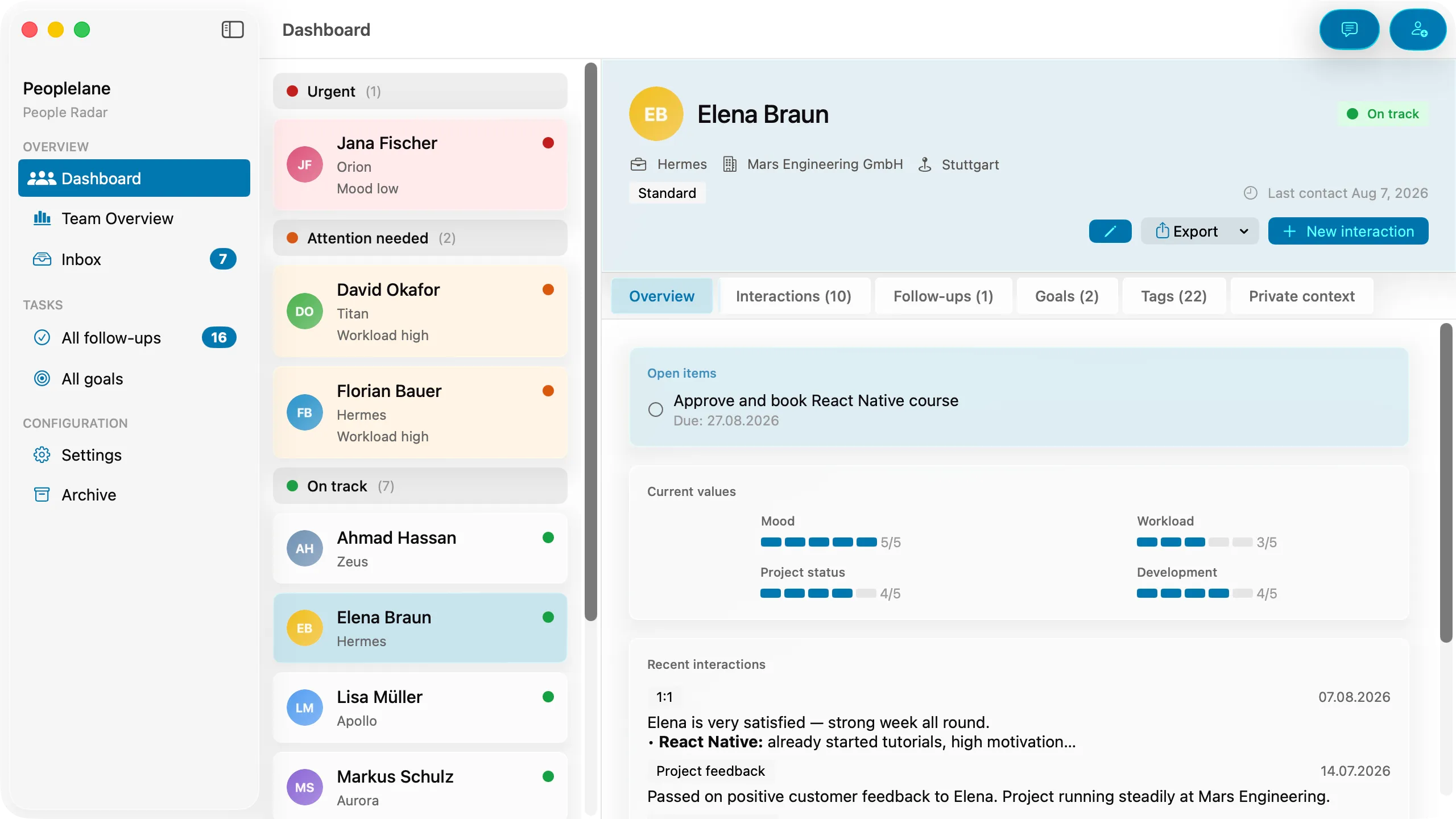
In Peoplelane, each person has one continuous record: the question you asked, what they said, and the follow-up it created, all dated and in one place. A two-minute read before a 1:1 tells you whether last month’s career question ever got revisited, or whether the “you’ve seemed quieter” conversation from three weeks ago needs a check-in now. The questions above work better when you can see, at a glance, which ones you’ve already asked this person, and which one is overdue.
Keep the context for your next 1:1
Peoplelane is a private Mac workspace for conversation history, open follow-ups and development goals.
Request beta access