A two-minute entry that pays off in six months
Fictional example: “14 Oct — Maya ran sprint planning for the first time. She cut the scope discussion from forty to fifteen minutes by proposing two options up front. She wants feedback on handling disagreement. I will share two observations in our next 1:1.” It takes two minutes to write.
In April, when you draft Maya’s promotion case, that entry is a concrete, dated example of facilitation. Without it, you would be writing from the impression left by the last fortnight.
What a leadership journal is, and what it is not
A leadership journal is your private, dated record of the conversations, decisions and observations that make up your work as a manager. It helps you remember, follow through and notice patterns. It is a working tool for better conversations.
It is not a shadow performance file. Formal concerns belong in the process your organisation defines, with the transparency and access rights that come with it. If you would not be comfortable with the person reading an entry, rewrite it as an observation or leave it out.
What to record
Record what you will need later, not everything that happened. A useful test: will this help me prepare a conversation, keep a promise or describe someone’s work fairly?
- Commitments: what you promised, and what others promised you
- Decisions and the reason behind them
- Concrete examples of good work, with the date and the impact
- Observations tied to a situation, not to a character trait
- Topics the person raised and wants to come back to
- Your own reflections: what you would do differently next time
Pick a cadence you can keep
The best journal is the one you still write in March. Short and regular beats long and occasional, so tie the habit to moments that already exist in your week.
- After each 1:1 or meaningful conversation: two to five minutes, while it is fresh
- Weekly: fifteen minutes to review open follow-ups and add a short reflection
- Quarterly: read back through each person’s entries before development or review conversations
Simple templates
Templates should prompt, not constrain. Start with these and drop any line you never use.
- Conversation entry: date · person · type (1:1, feedback, development) · what they raised · what we decided · my follow-ups · their follow-ups
- Example of work: date · situation · what they did · impact · who else saw it
- Weekly reflection: what went well · what I avoided · one commitment overdue · who I have not really spoken to
- Before a review: goals agreed · three dated examples · growth since last cycle · open questions to ask them
How the journal feeds 1:1s, reviews and promotion cases
Before a 1:1, read the last entry and the open follow-ups. Start by reporting on your own commitments; that habit builds more trust than any question list. During review season, your dated examples counter recency bias and make feedback specific enough to act on.
For promotion cases, encourage each person to keep their own brag document of achievements. Your journal complements it with the manager’s view: examples you observed, feedback from others and the growth you discussed together. Share the examples you plan to use with the person before they appear in a formal document, so nothing comes as a surprise.
Keep it private and fair
A private record of your meetings carries responsibility. Keep it on an account and device you control, subject to your employer’s policy, and understand who could access it. Write facts and observations rather than diagnoses or speculation. Delete entries that no longer serve a purpose, and remember that in many jurisdictions people can request access to personal data held about them.
If you use AI to tidy up entries, check where the text is processed and read every draft before saving it. Generated summaries can attribute statements to the wrong person or add certainty that was never there.
Which tool to keep it in
A paper notebook is private and fast but hard to search. A notes app or plain text files work well if you are disciplined about one file per person and a separate list of commitments. A shared workspace is the wrong place for private reflections, especially when the organisation administers it.
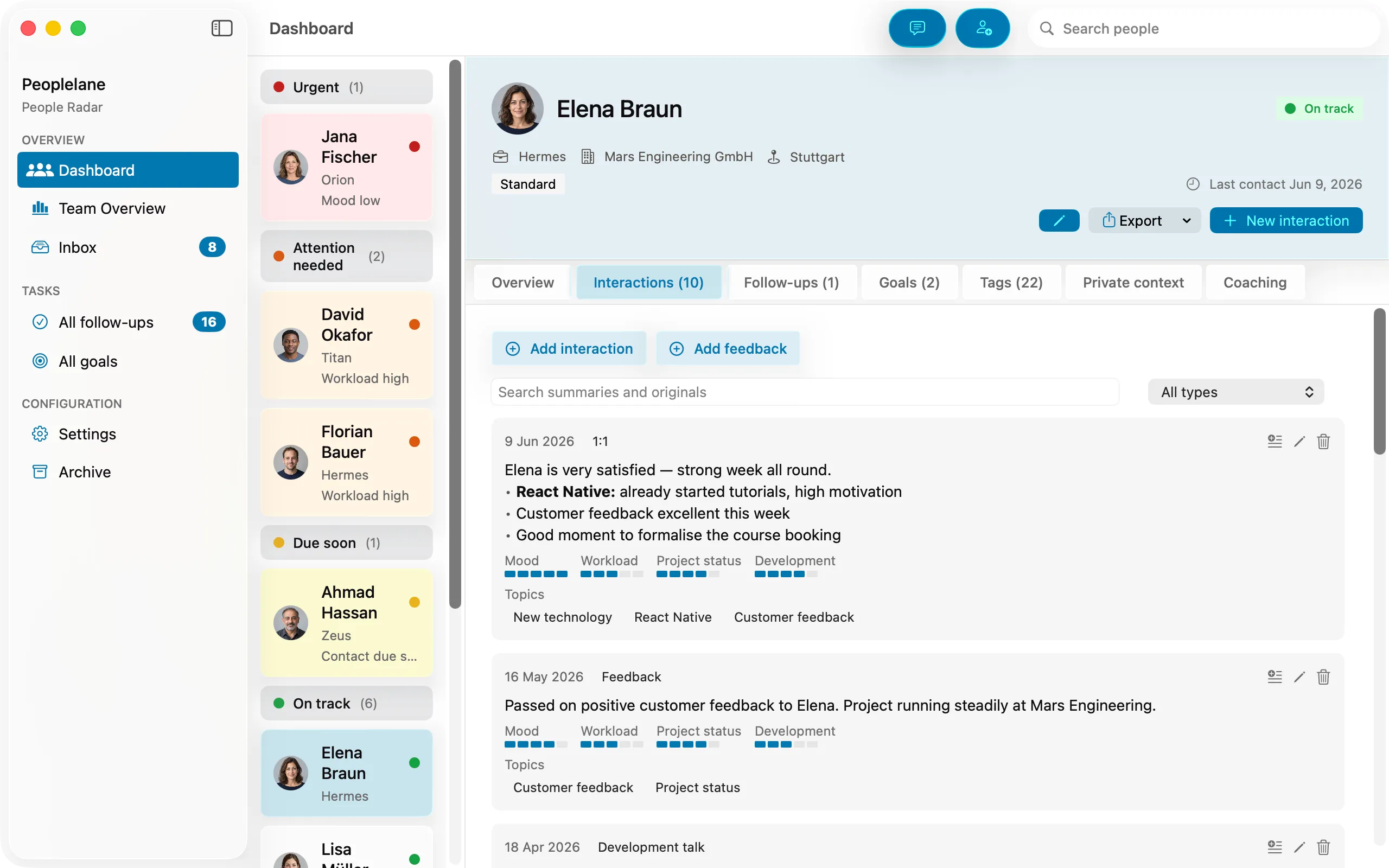
Peoplelane is one option if you use a Mac. It organises the journal by person: dated conversation history, follow-ups with status and due dates, development goals and a private context area, stored in a workspace on your Mac and usable offline. You can export a person’s record as a document. It does not offer collaboration or a web version, and the free plan covers up to three people.
Keep the context for your next 1:1
Peoplelane is a private Mac workspace for conversation history, open follow-ups and development goals.
Notify me at launch